Bizarre
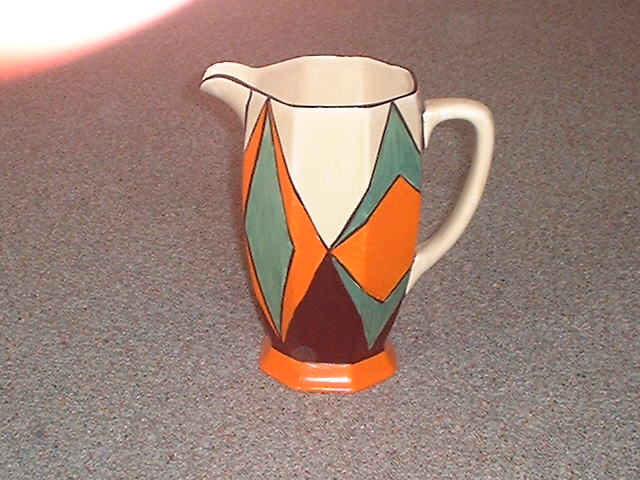
There are some designers so iconic that even somebody who is not in the least bit interested in antiques can recognise them. You’ve only got to watch one episode of bargain hunt or similar and the chances are you will hear certain names; Moorcroft, Murano, Whitefriars, Clarice Cliff.
With Clarice Cliff in particular, it is the colours and the simplicity of the designs that make the pieces so easily recognisable.
She started as a gilder at the age of 13 in potteries around the Stoke-on-Trent area before moving to A.J. Wilkinson in Burslem as an apprentice potter, where she was given the opportunity to practice some of her own work.
By the time she was 25 her talent had been noticed and by age 28, she was signing her name along with the backstamp of the pottery. It didn’t take long before her designs caught the eye of the public and she became a household name.
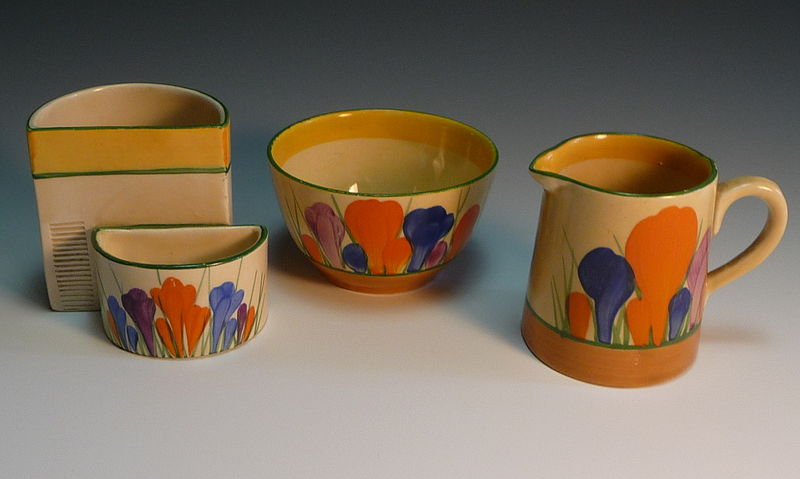
Crocus
The most iconic of all of Cliff’s designs are probably those based around crocuses as this was one of the most long produced patterns. It is still possible to pick up a piece of the more common designs for under £100 and although not as popular with the general public as it was 20-30 years ago, Cliff’s more unusual designs can still command staggering prices at auction. In 2009, an 18 inch wall charger sold for an incredible £20,500!
It is this interest in Cliff’s work which has driven people in the past to fake popular designs and try to pass them off as originals. If done well, it can take years for these forgeries to come to light, passing from collector to collector through auction house and private sales.
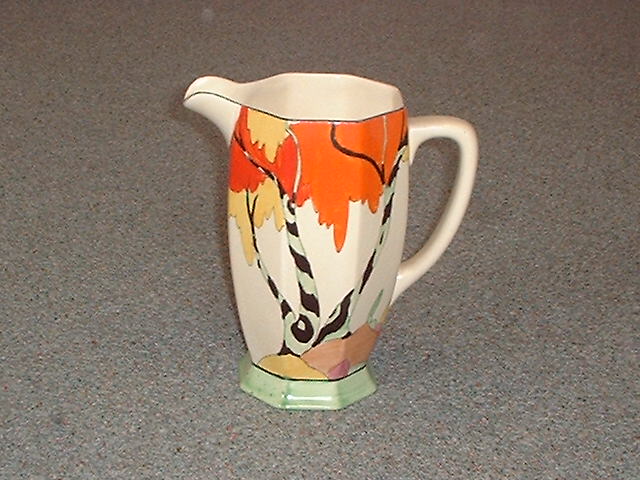
Honolulu
One such forgery is pictured below. The scene painted on the front of the plate is called “Idyll” (sometimes referred to as Crinoline Lady) and genuine examples of this pattern can be worth thousands of pounds.
This one, however, is not a genuine article. It is a forgery, produced with the intention to deceive, and to my knowledge it passed from an auction house, to a dealer and then onto another dealer until it was eventually spotted by a member of the Clarice Cliff Collector’s Club and it has now been taken off the market. Forgeries like this actually harm the collectors market and it is also illegal to sell them under the Trade Descriptions Act.
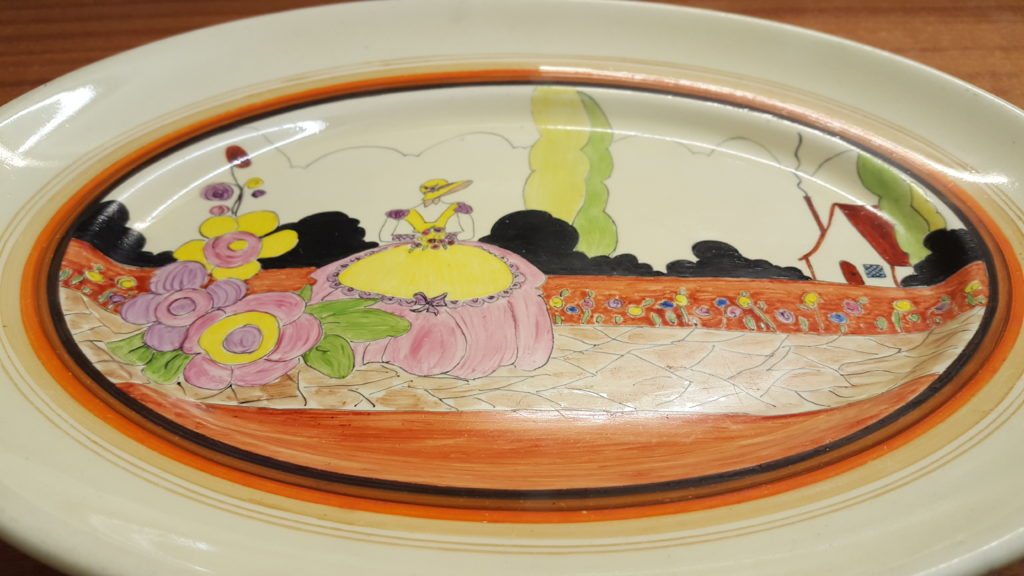
The Clarice Cliff “Idyll” forgery
An interesting thing about this item is that the actual platter is a genuine piece of Clarice Cliff from sometime around the 1930s. The backstamp is genuine and the orange and black banding around the edge are original and hand-painted. However, this platter was never produced with the Idyll pattern painted on the front, so it immediately stood out when an expert saw it. Also, the shades of orange in the banding should match the shade used for the foreground and the flower bed in the background. To a trained eye, this is a definite forgery. But to the average person, or even a casual collector, this looks like the real thing, and it fooled quite a few different people.
Having said all that, I actually think this item 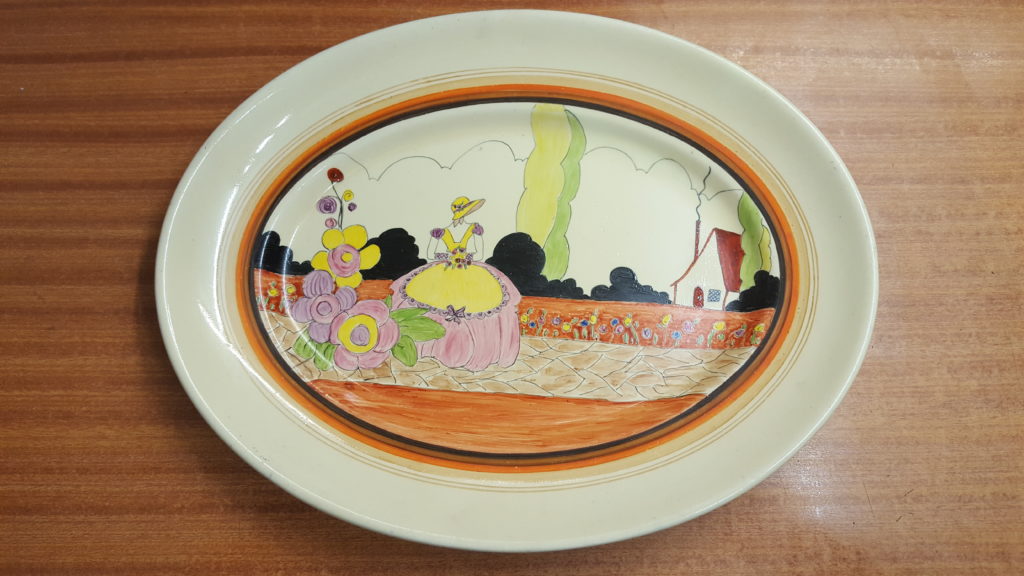 has some merit. It is fascinating to think that somebody went to great lengths to hand paint this scene on an item that did have a certain appeal and a value and in doing so, they made the entire thing completely worthless. The original platter will never be the same.
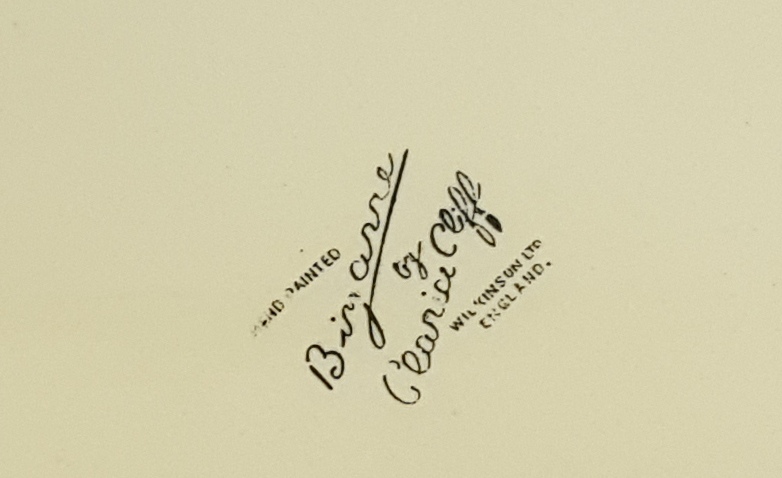
Genuine backstamp on the fake platter
It was certainly interesting to learn that there are some forgeries out there and that some of them are so good that they may very well be in your collection at home.
So beware if you are looking for the real thing. Always check with a reputable source and don’t part with your money until you are sure.



 This is a short description of Hungerford in 1791 and whilst the town has changed a little, one can still see our eighteenth century town.
 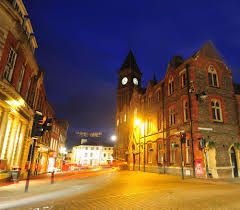 The streets in Newbury have a sense of space but the town has obviously been built up since 1791.
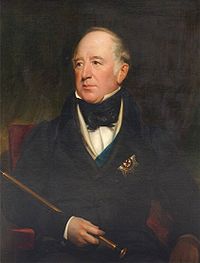

 Here in Hungerford in the early spring of 2016, I have this book in front of me.
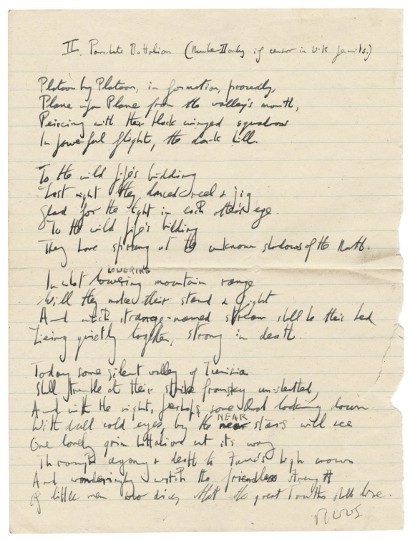
 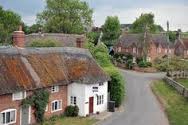 You can see the history of the now sleepy Bedwyn in this short and slightly mysterious account.
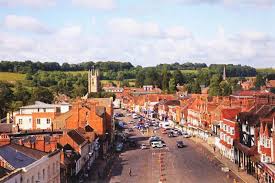 Marlborough 76 miles from London, so called from the chalky soil in which it is situated is prettily built, but consists chiefly of one large straight street, with piazza’s along one side of it.
 The alms-houses are still there and have not changed that much in the last two hundred and twenty-five years.
  When one enters an antique shop or an Arcade there are three things that will always happen. Firstly, within minutes you will find a copy of The Rubaiyat of Omar Khayyam (usually the Fitzgerald translation). Secondly you will find for sale the Tri-ang lorry you had when you were a child which you managed to batter to destruction before you were twelve. Sadly you note that if you had not been such a horror then you might have been some fifty pounds richer now. Thirdly, you will see an animal or a fish looking startled (or not) in a glass case.
  One of the many pleasures of walking down Hungerford High Street (there are many if you look) is that you cannot miss these creatures in their glass cases looking out onto the West Berkshire day. A lot of these are Victorian and I always consider that they are like the H George Wells character in the 1960 movie, The Time Machine. There is a scene in the movie where Wells uses his machine to travel to the future from 1899. Although the machine stays in roughly the same place the world around him changes as the future develops. A Victorian fox looking out onto our High Street will have seen a lot of changes and will do as we progress. Obviously the fox would have been in situ for the last hundred or so years looking at our main street but he is encased in a time capsule which has not changed since he was positioned by our forefathers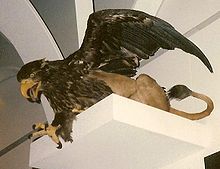

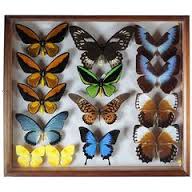 As the taxidermy techniques became more sophisticated, museum collections grew and now nearly two hundred years later we have collections in the United Kingdom and Europe to be proud of. I remember as a child being dragged around various dusty museums and seeing wild animals although long dead as real as you could see them. This made a lasting impression on me although I always looked forward to the collections of butterflies and moths.
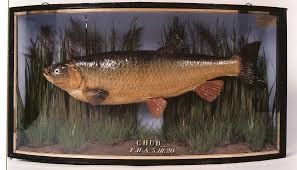 Apart from butterflies and moths one of my favourites are the various fish that you see mounted in cases (often in pubs) where a lucky fisherman, proud of his catch has had his catch stuffed and placed in glass case for posterity. It is the detail that fascinates me .
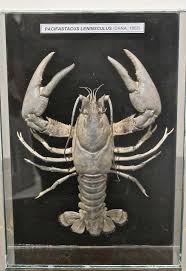 The list is endless but if you are in a pub or elsewhere then they are fun to look at. Whilst on the subject of pubs, there is an interesting one in Beesands in South Devon (near the ruined village of Hallsands). On the wall to the left as you enter is the biggest lobster that you are ever likely to see caught, I believe off of Cape Cod in 1956. The size is awesome especially for a lobster layman such as myself. What further amused me was that in a recent advertisement for the pub that this huge lobster was released from its case and placed on the sea wall with various other items. So near the sea but so far.
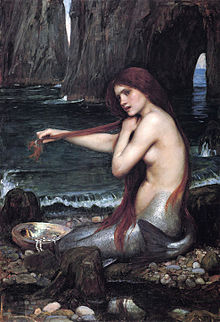 However, if I ever walk down Hungerford High Street or elsewhere and see a mermaid in a glass case then I will most definitely change my choice of ale. For the time being though I will continue to admire the work of these Victorian taxidermists as I peer curiously into these glass cases.
 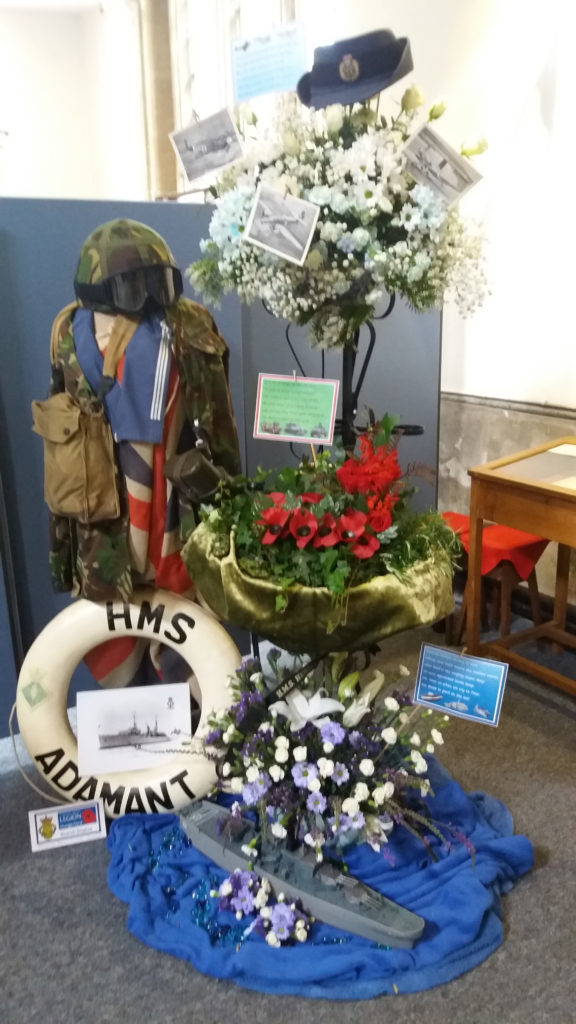 As part of Hungerford and District Community Arts Festival (HADCAF) and to coincide with the 200 year anniversary of St. Lawrences Church in Hungerford, a flower festival was held at the church featuring themed displays.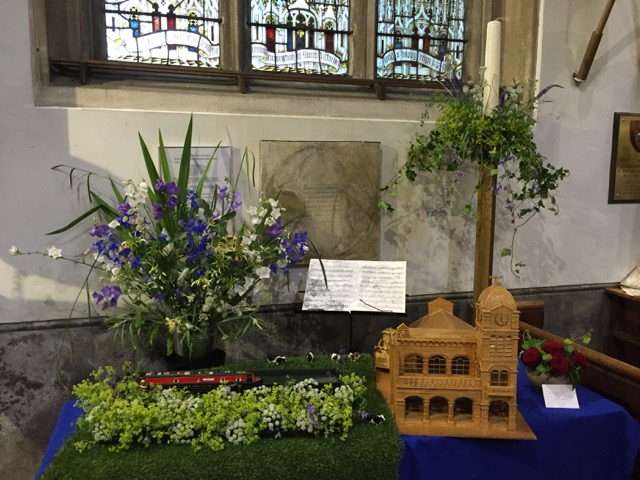
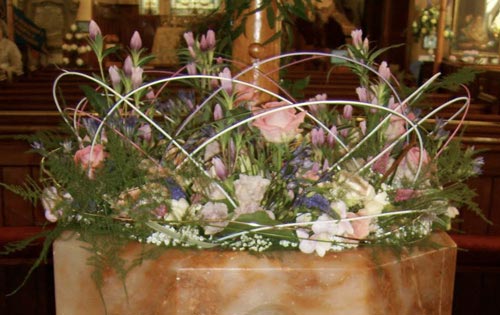 The theme for the flower displays by local organisations was to depict a song or hymn and the numerous floral arrangements varied from children’s nursery rhymes through to well known songs to favourite hymns.
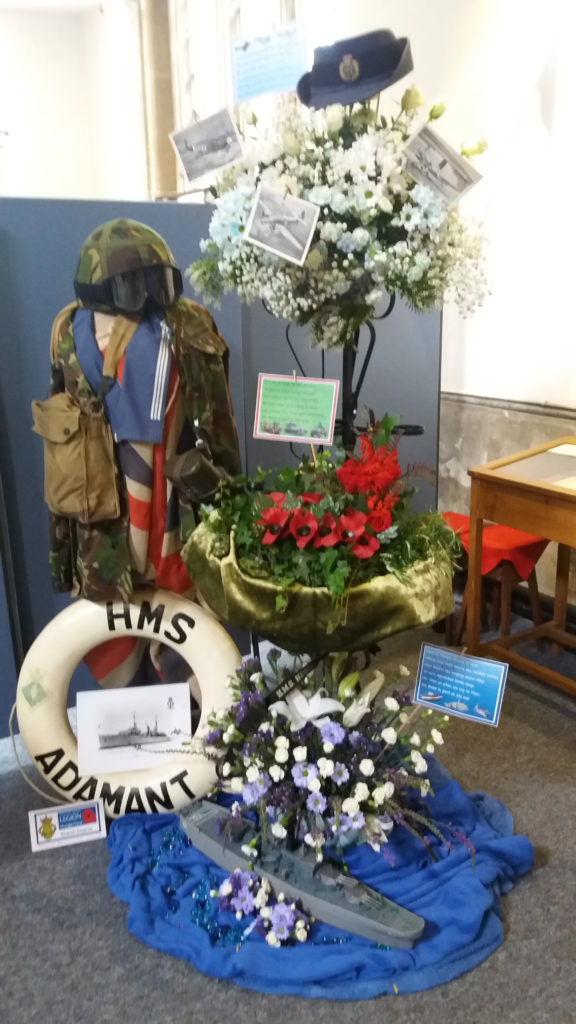 The Royal British Legion Hungerford Branch chose ‘Eternal Father’ as their theme and produced a three tier display depicting the three armed forces with accompanying memorabilia kindly loaned by Hungerford Arcade.
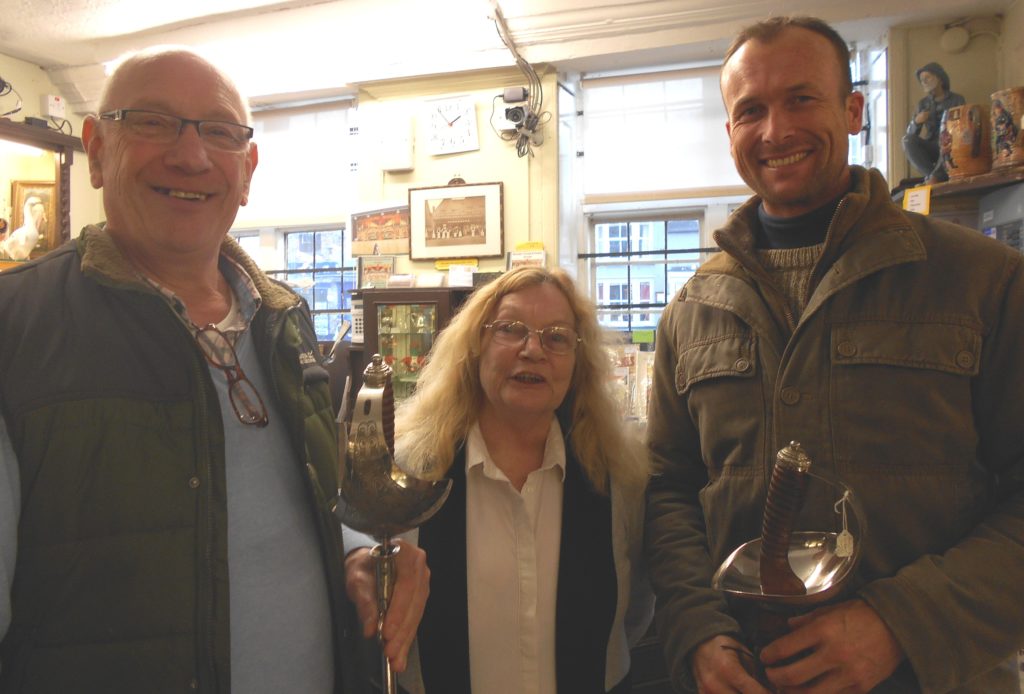
 When Kevin and Mary McLaren-Dunbar, along with their dog Kountess Kiki came into the Arcade looking for character jugs, they were not disappointed. In fact, they were over-the-moon to find some that did did not have and had been searching for for quite a long time. When they came to the desk to purchase the jugs, Kevin told us that he has a collection of at least 7,000 which will all be going to his Strathgart Hunting Lodge in Inverness.